Here’s the thing about Christmas: somewhere between the fifth rendition of “Jingle Bell Rock” at Target and your third candy cane latte (because apparently we’ve run out of things to put peppermint in), it’s surprisingly easy to forget we’re technically celebrating a birth. Not just any birth. The kind that theologians have been dissecting for two millennia, that inspired Michelangelo to paint ceilings and medieval peasants to build cathedrals, and that still makes grown adults volunteer to stand in a barn at midnight dressed as shepherds.
According to Pew Research, approximately 2.3 billion Christians worldwide celebrate Christmas, yet only 47% of Americans include church attendance as part of their Christmas traditions. That’s like throwing a birthday party where two-thirds of the guests skip seeing the birthday person. Awkward doesn’t quite cover it.
CHRISTIANS WORLDWIDE CELEBRATE CHRISTMAS
Yet only 47% of Americans attend church services during the holiday season
But here’s what makes Christian Christmas traditions genuinely fascinating: they’re not about achieving some Pinterest-perfect nativity scene or winning the neighborhood light display competition. They’re about communities finding moments of genuine meaning in the chaos. From the haunting beauty of Orthodox midnight liturgies to the joyful pre-dawn Marathon that is Filipino Simbang Gabi, Christian Christmas celebrations offer something our commercialized version consistently misses: actual theological weight.
So let’s explore how Christians around the world honor what they believe is God becoming human, beyond the wrapping paper and the questionable fruitcake.
Advent: The Pre-Game Show That’s Actually Holier Than the Main Event
Most people think Christmas starts when stores put out decorations (so, August?). Christians, however, have been playing the long game for centuries. The Advent season begins four Sundays before Christmas Day, usually landing somewhere between November 27 and December 3. It’s basically Christianity’s version of training camp before the big championship.
The word “Advent” comes from the Latin adventus, meaning “coming” or “arrival”. It’s not just about waiting for Christmas morning like an impatient kid; it’s a deliberate period of spiritual preparation, reflection, and if you’re following the traditional rules, some surprisingly strict fasting. (More on that fun detail later.)
The Advent Wreath: Candles With Homework
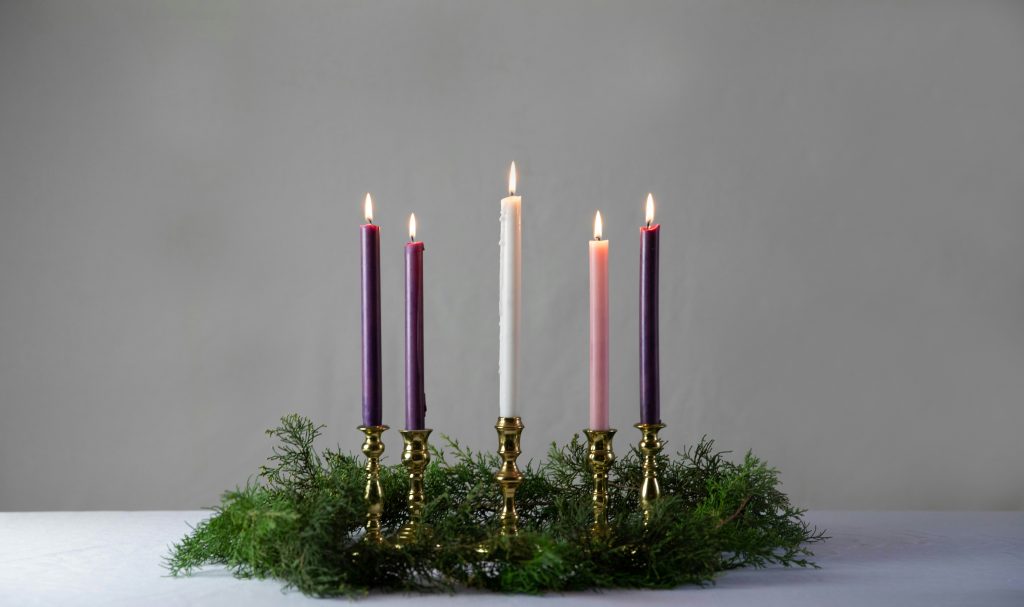
Walk into almost any Christian church during Advent and you’ll spot the Advent wreath: a circular arrangement of evergreen branches with four candles standing at attention like soldiers. This isn’t just festive decoration; it’s loaded with symbolism that would make a high school English teacher proud.
The wreath’s circular shape represents eternity and God’s endless love, because apparently even holiday decorations need to convey infinite concepts. The evergreen branches symbolize everlasting life, which makes sense; nothing says “immortality” quite like a plant that refuses to die despite your neglect.
✝ The Four Weeks of Advent
🕯 Week 1
Hope
🕯 Week 2
Peace
🕯 Week 3
Joy
🕯 Week 4
Love
Those four candles? Each one represents a week of Advent and traditionally corresponds to specific themes:
- Week 1 (Hope): Purple candle, focusing on prophetic hope and Old Testament prophecies about the Messiah
- Week 2 (Peace): Purple candle, reflecting on the Bethlehem journey and the “Prince of Peace”
- Week 3 (Joy): Rose or pink candle (called Gaudete Sunday, from the Latin for “rejoice”), marking the halfway point
- Week 4 (Love): Purple candle, contemplating God’s love demonstrated through the incarnation
Some traditions add a fifth white candle in the center, the Christ candle, lit on Christmas Day. Because four candles apparently weren’t dramatic enough.
The color scheme isn’t random either. Purple represents royalty and penance (so, royal sorry-ness?), while the single rose candle provides a visual break in the somber preparation, like a theological intermission.
Advent Calendars: From Devotion to Chocolate Capitalism
Modern Advent calendars, those cardboard contraptions dispensing daily chocolate or tiny toys, have their roots in 19th-century German Protestant traditions. Originally, families would mark the days until Christmas by lighting candles, making chalk marks on doors, or hanging devotional images.
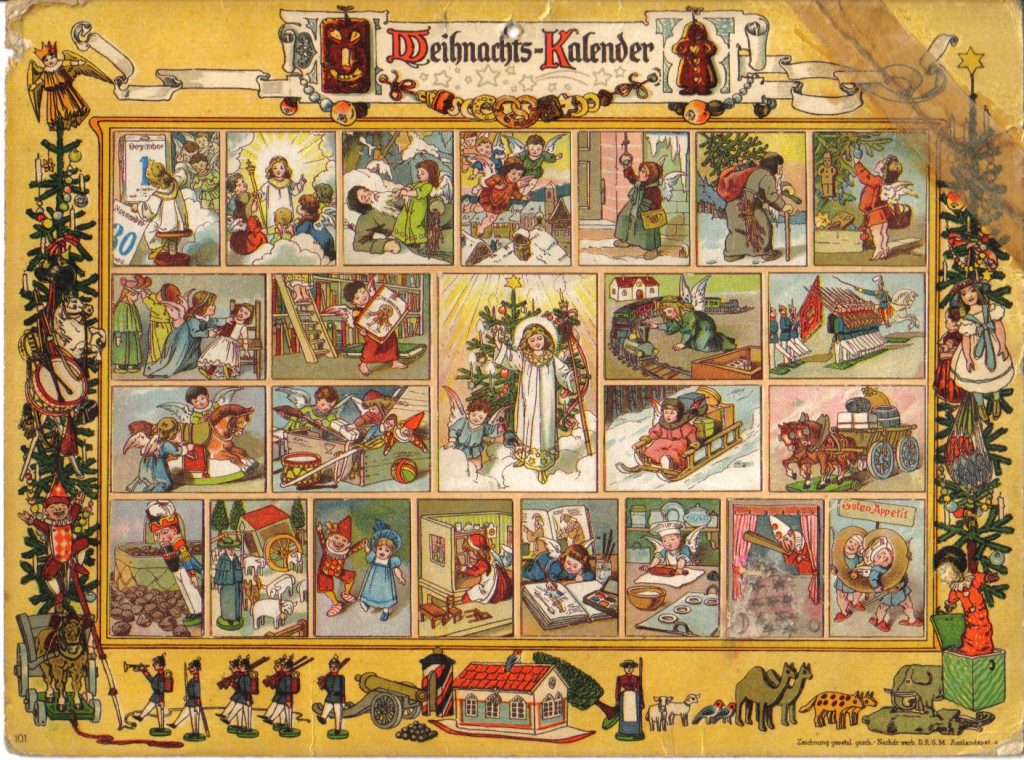
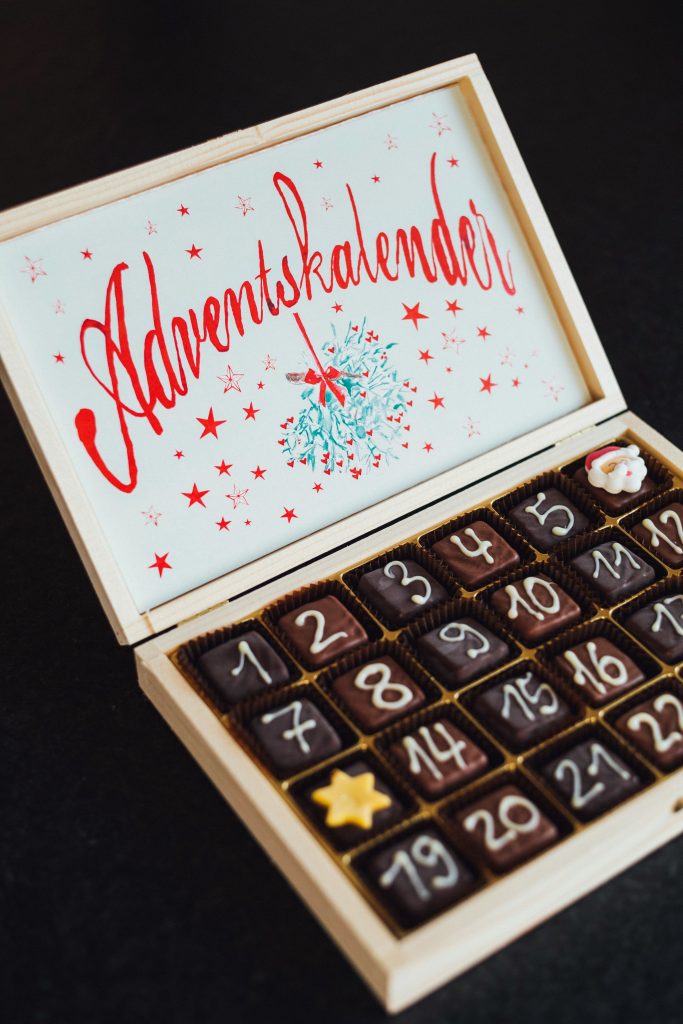
The first printed Advent calendar appeared in 1908, created by Gerhard Lang, who was apparently inspired by his mother’s homemade version involving 24 cookies. (Shoutout to Mrs. Lang for pioneering the “make waiting more tolerable with sugar” approach.)
Today’s chocolate-filled versions are… let’s call them “spiritually distant cousins” of the original concept. Though to be fair, no one ever said spiritual preparation couldn’t involve nougat.
For Christians maintaining the devotional aspect, many Advent calendars now include daily scripture readings, prayers, or small service activities. It’s the theological equivalent of turning a shopping list into a treasure hunt: more intentional, slightly more work, considerably more meaningful.
Different Denominations, Different Advent Vibes
Not all Christian groups observe Advent identically. It’s like how different families have different Thanksgiving traditions, except with more theological implications.
Catholic and Anglican traditions follow the liturgical calendar closely, with specific Mass readings, purple vestments for priests, and that whole Advent wreath situation. They take the penitential aspect seriously: historically, Advent was considered a “mini-Lent” with fasting requirements.
Lutheran and other mainline Protestant churches generally observe Advent with similar practices but maybe slightly less intensity. They keep the liturgical colors, the wreath, and the scripture readings, but the fasting expectations have… relaxed significantly.
Orthodox Christians have their own Advent-adjacent season called the Nativity Fast, which starts November 15 and lasts 40 days. Because apparently four weeks wasn’t challenging enough.
Evangelical and non-denominational churches often acknowledge Advent but with less liturgical structure. They might have an Advent wreath in the sanctuary and preach Advent-themed sermons, but you’re less likely to encounter color-coded candles and ancient Latin terms.
Why Advent Matters (Beyond the Candles)
The genius of Advent is counter-cultural: it forces you to slow down when everything else is speeding up. While retail stores blast “It’s the Most Wonderful Time of the Year” on November 1st, Advent says, “Hold on, we’re not there yet. Let’s actually think about what we’re celebrating.”
It reframes Christmas from a surprise event to an anticipated arrival. Christians believe they’re preparing not just to remember a historical birth, but to encounter something — someone — transcendent. The waiting itself becomes spiritually productive, like letting bread dough rise. You can’t rush it, and the waiting is part of what makes the final result worthwhile.
Plus, lighting candles weekly gives you something to do besides stress about gift shopping. That’s not nothing.
Midnight Mass & Christmas Eve Services: The Most Holy Insomnia You’ll Ever Experience
There’s something profoundly strange about voluntarily staying awake until midnight, or waking up at midnight, to attend a religious service. It violates every modern productivity principle. It’s inefficient, it’s exhausting, and it plays havoc with your sleep schedule.
It’s also one of the most powerful Christian traditions worldwide.
Three separate Masses:
• Midnight Mass
• Dawn Mass
• Day Mass
5pm-11pm start times
Candlelight + “Silent Night”
60-90 minutes
The History: Why Midnight?
The tradition of Christmas Eve and midnight services traces back to early Christianity. According to various sources (which may or may not be historically airtight), Pope Sixtus III instituted a midnight Mass in 5th-century Rome. The timing wasn’t arbitrary; early Christians believed Jesus was born at midnight, though the Bible provides zero actual evidence for this specific detail.
Theologically, the midnight hour carries symbolic weight: it represents the transition from darkness to light, from waiting to fulfillment, from the Old Covenant to the New. Christians see it as the moment when, as the Gospel of John puts it, “the Word became flesh and dwelt among us.” No pressure for a church service to capture that adequately.
Catholic Midnight Mass: Three Services, One Very Long Night
Traditional Catholic Christmas celebration actually involves three separate Masses on Christmas:
- Midnight Mass (Missa in Nocte): The big one, starting at midnight, focusing on the nativity itself
- Dawn Mass (Missa in Aurora): Held at sunrise, emphasizing the shepherds’ visit
- Day Mass (Missa in Die): Celebrated during daylight hours, reflecting on the theological meaning
Most Catholics pick one. Attending all three is either deeply devout or evidence of significant masochism. Possibly both.
Midnight Mass features some of the most beautiful liturgy of the entire church year. Incense fills the air (unless you have allergies, in which case you’re having a different kind of spiritual experience). Candlelight creates dramatic shadows across centuries-old architecture. The choir performs compositions by masters who understood that theology sometimes needs a full orchestra.
The Gospel reading is Luke 2:1-14, the nativity narrative starting with “In those days a decree went out from Caesar Augustus…” If you’ve attended even one Christmas service, you’ve heard this passage. It’s the theological equivalent of a greatest hit.
Protestant Christmas Eve Candlelight Services: The Democratized Version
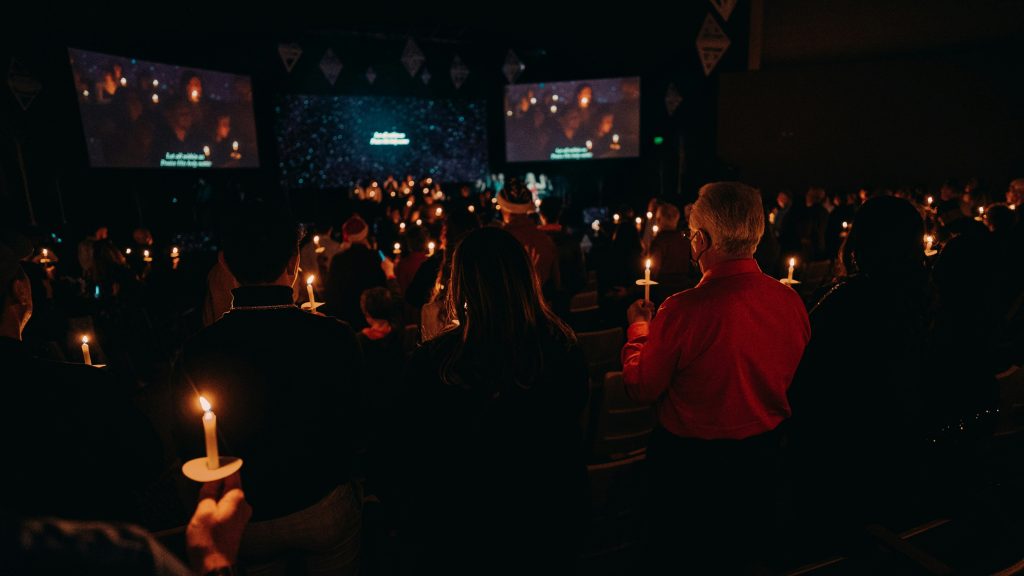
Protestant Christmas Eve services typically skip the midnight timing, most start between 5pm and 11pm, acknowledging that not everyone’s circadian rhythm aligns with theological symbolism. They’re generally shorter than Catholic Mass (60-90 minutes versus potentially 2+ hours) and focus heavily on congregational participation.
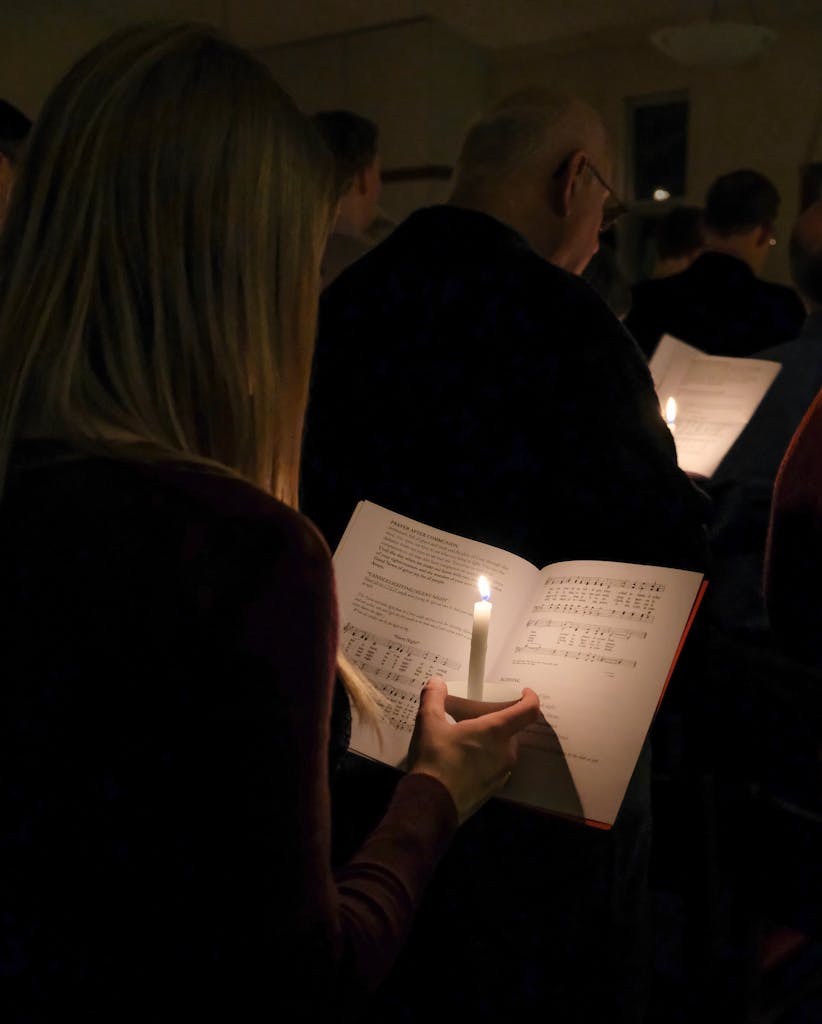
The signature moment: the candlelight portion, usually during “Silent Night”. Someone lights the first candle from the Christ candle, then methodically passes the flame person-to-person until the entire sanctuary glows. It’s breathtaking when everyone cooperates, mildly terrifying when someone’s wearing particularly flammable hair products.
These services blend traditional elements with accessibility. You’ll get the Christmas story, familiar carols, probably a sermon about God becoming vulnerable, and communion (depending on the denomination). The vibe is less “ancient liturgical mystery” and more “warm family gathering that happens to be about God”.
Orthodox Christmas Eve Divine Liturgy: When January 7th is the Real Christmas
Orthodox Christians celebrate Christmas on January 7th; or rather, they celebrate on December 25th on the Julian calendar, which corresponds to January 7th on the Gregorian calendar most of the world uses. Explaining this to confused non-Orthodox friends is its own special Christmas tradition.
The Christmas Eve Divine Liturgy in Orthodox churches is an entirely different experience. It’s longer (easily 2-3 hours), involves more standing (Orthodox churches aren’t big on pews), and includes liturgical elements unchanged for over a thousand years. The priest faces east toward the altar, incense is mandatory not optional, and the iconography covering every surface isn’t decorative; it’s considered windows into heaven itself.
The Liturgy includes the Vesperal Divine Liturgy of St. Basil, featuring eight Old Testament readings prophesying Christ’s birth. It’s like a theological time-travel experience, connecting ancient Jewish prophecy with Christian fulfillment claims.
After the service, many Orthodox families continue the Nativity Fast until they return home, then break it with a feast. Because if you’re going to fast for 40 days, you should probably end it properly.
Why These Services Hit Different
There’s something about gathering in the dark (or staying up way past reasonable bedtime) that creates a unique headspace.
The timing disrupts normal routines, which is kind of the point. You’re tired, slightly disoriented, probably caffeinated beyond wisdom, and somehow more open to experiencing something transcendent.
These services attract the faithful and the occasional, the “twice-a-year Christians” (Christmas and Easter) alongside the every-Sunday regulars. Most churches welcome both without judgment, understanding that Christmas Eve might be someone’s one contact with religious community all year.
The music plays a huge role. “O Holy Night” hits differently at midnight. “Hark the Herald Angels Sing” feels more triumphant when you’re exhausted. “Silent Night” by candlelight has converted more skeptics than a thousand theological arguments.
And there’s practical wisdom here: attending a Christmas Eve service gets the religious obligation out of the way before the chaos of Christmas morning. You’ve acknowledged the theological significance, participated in communal worship, and now you can focus on the presents and the inevitable family drama with a slightly clearer conscience.
The Nativity Scene: Biblical Storytelling in Three Dimensions (Plus Artistic License)
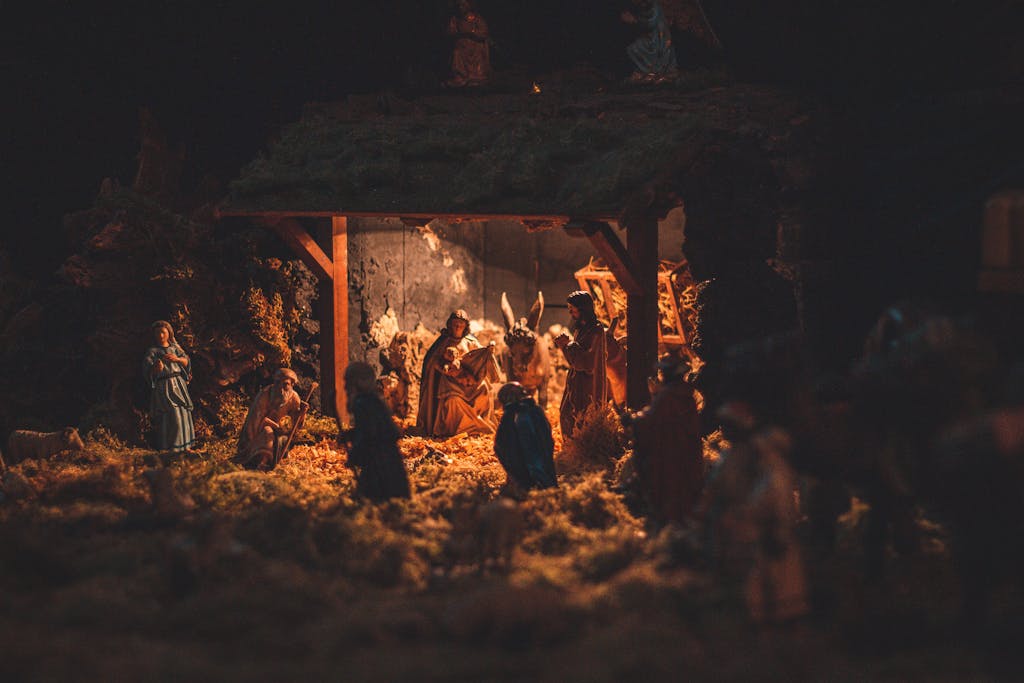
Walk into any church during Christmas and you’ll encounter some version of the nativity scene: a miniature theatrical set permanently frozen at the moment of Christ’s birth. Baby Jesus (usually disproportionately large) lies in a manger, surrounded by Mary, Joseph, shepherds, wise men, various livestock, and depending on the church’s decorating committee, possibly some creative additions like penguins or dinosaurs. (Yes, this happens.)
This tradition is so ubiquitous that it’s easy to forget someone had to invent it. That someone was St. Francis of Assisi, and his reasons were more subversive than you’d expect.
St. Francis and the First Living Nativity (1223 AD)
St. Francis — the medieval Italian friar famous for talking to animals and generally being everyone’s favorite saint — created the first live nativity scene in Greccio, Italy, on Christmas Eve 1223. But he wasn’t just being cute or crafty; he had a point to make.
1223: Greccio, Italy
St. Francis creates first live nativity scene
The Innovation
Real people, real ox, real donkey, actual cave
The Purpose
Visual representation for people who couldn’t read Latin
Medieval church services were conducted entirely in Latin, which most people didn’t understand. The theological discussions about Christ’s birth happened at an intellectual altitude that excluded the majority of believers. Francis, who had this radical notion that everyone should actually understand the faith they practiced, decided to create a visual representation of the Christmas story.
He arranged a live display with real people, a real ox, a real donkey, and actual straw in an actual cave. No dainty ceramic figurines, this was immersive theater meets theological instruction. According to Thomas of Celano’s biography of Francis, the saint wanted people to “see with bodily eyes the hardships of [Jesus’s] infant state”.
The innovation was showing, not just telling.
People who couldn’t read scripture or parse Latin liturgy could understand a baby in a feeding trough surrounded by animals. It was brilliant pedagogical design disguised as holiday decoration.
What the Bible Actually Says (Spoiler: It’s Brief)
The nativity story appears in only two of the four Gospels: Matthew and Luke. And they’re not even telling the same parts of the story.
Luke 2:1-20 gives us most of what we visualize: Caesar Augustus’s census, the journey to Bethlehem, “no room at the inn,” the baby wrapped in swaddling clothes and laid in a manger, shepherds receiving angelic announcements, and the heavenly host declaring “Glory to God in the highest”.
Matthew 1:18-2:23 focuses on Joseph’s perspective, the wise men following a star, King Herod’s paranoia, the family’s flight to Egypt, and the infamous massacre of male infants (cheerfully omitted from most nativity scenes).
Combine these accounts and you get the traditional narrative. But notice what’s not explicitly there:
- No stable is mentioned. Luke only says the baby was placed in a manger (animal feeding trough) because there was no room in the kataluma, which could mean “guest room”, “inn”, or just “space”. The stable is a reasonable inference (mangers are typically in buildings housing animals), but it’s not stated.
- No mention of a donkey. Mary might have ridden one to Bethlehem, or she might have walked. The Bible doesn’t specify.
- The wise men and shepherds probably didn’t arrive simultaneously. Shepherds came the night of the birth. The wise men (Matthew never says there were three) arrived significantly later, possibly months or even up to two years after, which is why Herod ordered the killing of boys under two years old.
- The wise men weren’t kings. They were magi, probably Persian priests or astrologers. The “three kings” tradition developed later, partly from connecting them to Old Testament passages about kings bearing gifts.
- Their names — Gaspar, Melchior, and Balthazar — appear nowhere in scripture. That’s pure tradition, possibly originating from a 6th-century Greek manuscript.
So the classic nativity scene is really a composite narrative, blending two Gospel accounts, adding traditional embellishments, and compressing the timeline for visual convenience. It’s like a historical movie “based on true events”: the core is there, but liberties were taken.
Cultural Variations in Nativity Representations
Different cultures have created wildly diverse nativity traditions, each reflecting their own artistic sensibilities and theological emphases.
Filipino Belen traditions feature elaborate nativity displays often including entire miniature villages surrounding the holy family. Some families spend months constructing these detailed scenes, which might incorporate local architectural styles, indigenous materials, and sometimes mechanized elements. The commitment level ranges from “modest display on a table” to “we’ve converted the entire garage”.
Mexican Nacimientos similarly expand beyond the basic figures to create extensive dioramas representing the journey to Bethlehem, the town itself, and sometimes scenes from daily life in Mexico. The celebration of Las Posadas (December 16-24) involves reenacting Mary and Joseph’s search for lodging, literally going house-to-house in the neighborhood.
German Christmas markets feature nativity scenes carved from wood with extraordinary craftsmanship, continuing a woodworking tradition dating back centuries. The Erzgebirge region is particularly famous for these, with entire villages specializing in Christmas figurine production.
African nativity scenes often portray the holy family with African features and in African settings, challenging the European artistic tradition that dominated for centuries. This contextualization reflects a theological point: the incarnation is meaningful across all cultures, not just those historically depicted.
Latin American nativity scenes frequently include not just the biblical characters but representations of local life: markets, musicians, villagers going about daily activities. The theological message: Christ enters ordinary human existence in all its forms.
Live Nativity Scenes: Modern Medieval Theater
Many churches continue St. Francis’s tradition with live nativity pageants, though with modern adaptations like heated barns and liability waivers. These range from simple displays (people standing still in costume) to full productions with dialogue, music, and actual livestock.
Children’s Christmas pageants are their own special subset of this tradition: adorable chaos where 5-year-olds dressed as sheep steal the show, angels’ halos fall off mid-performance, and at least one Joseph forgets to actually show up to Bethlehem. These productions rarely achieve theological profundity, but they nail the “humility and imperfection” aspect of the incarnation story.
The Theological Weight of the Manger
For Christians, the nativity scene’s power isn’t in its historical accuracy but in what it represents theologically: the doctrine of the incarnation. God becoming human.
The manger detail is crucial. This wasn’t a deity arriving with celestial fanfare and appropriate accommodations. This was God entering human existence in the most vulnerable form possible, in circumstances that were frankly undignified. Born to an unwed teenage mother, in an occupied territory, with his first bed being livestock’s dinner holder.
The symbolism is either profound or absurd depending on your perspective. Christians see it as demonstrating God’s identification with humanity’s lowest moments: poverty, vulnerability, displacement. The manger represents radical solidarity with human suffering.
Or, as one theologian supposedly put it:
The scandal isn’t that God became human. The scandal is HOW God became human.
That’s what nativity scenes (even the ceramic ones with unlikely animal combinations) attempt to capture: the claim that the infinite became finite, the eternal entered time, and the divine chose the uncomfortable circumstances of actual human birth over any form of dramatic appearance.
It’s either the most important thing that ever happened or the most elaborate story ever told. Christians bet everything on the former.
Christmas Day Worship: When Everyone Actually Shows Up (And Churches Prepare for Chaos)
Christmas Day falls on December 25th, obviously, but the church service experience varies wildly depending on what day of the week it lands. Christmas on a Sunday? Perfect! It’s already a church day. Christmas on a Wednesday? Now we have competing theological principles: is Christmas observance mandatory even when it’s logistically inconvenient?
Different Christian traditions answer this differently, but most agree: Christmas Day deserves dedicated worship beyond Christmas Eve services.
Why Christmas Day Services Matter
After the anticipation of Advent and the dramatic midnight services, Christmas Day worship serves a distinct purpose: celebrating the arrival itself without the exhaustion-tinged mysticism of the previous night.
These services tend to be shorter, more casual, and genuinely joyful. The theological heavy lifting happened last night; today is about celebration. It’s like the difference between a wedding ceremony and the reception afterward: one is solemn and meaningful, the other is “we made it, let’s party”.
Christmas Day services also accommodate people who couldn’t make Christmas Eve (work schedules, family obligations, basic human need for sleep) and families with young children who can’t reasonably stay up until midnight without catastrophic consequences.
Different Worship Styles Across Denominations
Liturgical churches (Catholic, Anglican, Lutheran, Orthodox on January 7th) maintain formal structure even on Christmas Day. You’ll get traditional liturgies, specific scripture readings, communion, and the full ceremonial treatment. The readings typically focus on the Prologue of John’s Gospel (1:1-18) — “In the beginning was the Word” — which explores Christmas from a cosmic, theological perspective rather than retelling the birth narrative again.
The Catholic Church’s three-Mass tradition means some priests are celebrating their third service in 12 hours. These men are running on communion wine and theological adrenaline at this point.
Contemporary Protestant churches might break from their usual casual format to include more traditional elements: Christmas hymns instead of contemporary worship songs, perhaps communion, maybe even a few liturgical touches. Or they lean fully into the celebratory atmosphere with upbeat music, shortened sermons, and children participating throughout.
Non-denominational and evangelical churches often do special Christmas services that feel more like events than traditional worship. Think full band, professional lighting, possibly a dramatic performance or video element, and a message about the meaning of Christ’s birth delivered in accessible language. Some churches hold Christmas Eve services exclusively and skip Christmas Day entirely unless it falls on Sunday.
The Music: Greatest Theological Hits
Christmas Day worship music leans heavily on the classics; hymns that have survived centuries because they actually work:
“Hark! The Herald Angels Sing” (1739) combines Charles Wesley’s lyrics with Mendelssohn’s melody to create something genuinely rousing. “God and sinners reconciled” is a theologically loaded phrase wrapped in singable packaging.
“Joy to the World” (1719) by Isaac Watts is technically based on Psalm 98, not the nativity story, but its association with Christmas is permanent. It’s impossible to sing without at least a little triumph creeping into your voice.
“O Come, All Ye Faithful” (18th century) invites participation; you’re not just observing, you’re being called to “come and behold him”. It’s communal summons disguised as carol.
“Angels We Have Heard on High” features the “Gloria in excelsis Deo” refrain that requires you to hold notes for uncomfortable lengths. Surviving this without passing out becomes a personal achievement.
Contemporary churches add modern worship songs like “O Holy Night” (which technically dates to 1847 but gets included in contemporary services) and original compositions attempting to capture Christmas themes with fresh language.
Christmas Communion: Theological Layers
Many churches offer communion on Christmas Day, which adds another theological dimension. Christians view communion as remembering Christ’s death and resurrection, so taking it on his birthday creates an interesting temporal paradox: celebrating birth while symbolically participating in death.
But that’s actually the point. The incarnation (birth) is inseparable from the atonement (death and resurrection). Baby Jesus in the manger is only meaningful because of where the story goes. Christmas without Easter is just a nice birth story.
Taking communion on Christmas reminds believers that the baby in the manger came specifically to die, which sounds deeply morbid but is central to Christian theology. It prevents Christmas sentimentality from disconnecting Jesus’s birth from his purpose.
Family Church Attendance Traditions
Christmas Day services attract interesting demographics. You’ll see:
- Regular attendees who’d be there regardless of the holiday
- Extended families visiting from out of town, creating seating chaos
- Twice-a-year Christians fulfilling a sense of obligation or tradition
- Mixed-faith families where one person is Christian and others are accommodating
- Curious newcomers who figured Christmas was a safe time to try church
Churches handle this influx with varying grace. Some warmly welcome everyone regardless of attendance frequency. Others make subtle comments about “seeing some new faces” that land somewhere between welcoming and passive-aggressive.
Most churches prepare for Christmas attendance spikes by adding extra services, setting up overflow seating in fellowship halls, and praying the sound system doesn’t fail at crucial moments.
Post-Service Fellowship: The Sacred Snack Table
Many Christmas Day services include post-worship fellowship: cookies, coffee, and conversation in the church basement or fellowship hall. This social element shouldn’t be underestimated; for some people, it’s as important as the worship itself.
These gatherings create space for:
- Catching up with church friends you see less frequently
- Welcoming visitors without the pressure of formal greeting time
- Letting kids burn energy before the car ride home
- Creating community beyond just Sunday morning ritual
The quality of the coffee is inversely proportional to the church’s budget, but everyone drinks it anyway.
Balancing Worship and Family Celebration
Here’s the practical tension: Christmas Day worship competes with family obligations, present-opening schedules, and meal preparation. Families navigate this differently:
Some attend early morning services, then return home for presents and breakfast. Others open gifts first, then attend late-morning services. Some do Christmas Eve services precisely to avoid this conflict.
Churches have adapted by offering multiple service times, shortening service length, and being generally understanding when families skip or arrive late because a 6-year-old insisted on opening presents first. (The kid might be onto something theologically, experiencing gift-giving before intellectualizing it.)
The tension isn’t a bug; it’s a feature.
Christmas exists in the intersection of spiritual observance and family tradition. Getting both right simultaneously is basically impossible.
So most families oscillate between them, hoping good intentions count for something.
The Twelve Days of Christmas: Not Just an Increasingly Annoying Song
Quick quiz: When do the Twelve Days of Christmas occur?
If you answered “the twelve days before Christmas,” you’re in good company with most people and you’re also completely wrong. The Twelve Days of Christmas run from December 25th (Christmas Day) through January 5th, culminating in Epiphany on January 6th.
This means the Christmas season technically begins on December 25th, not before. Everything in Advent? That’s the preparation period. Christmas itself is a nearly two-week celebration.
Absolutely no one in modern Western culture observes this anymore. We’re done with Christmas by December 26th, when stores immediately pivot to Valentine’s Day displays and everyone on social media starts posting “New Year, New Me” content. But traditionally, Christians celebrated for twelve days, and in some traditions, they still do.
The Historical Background
The exact origin of the Twelve Days tradition is murky, which is standard for most Christian practices predating detailed record-keeping. It likely developed sometime in the Middle Ages, possibly influenced by ancient Roman winter festivals that also lasted multiple days.
The number twelve has obvious symbolic appeal (twelve apostles, twelve tribes of Israel), and ending the celebration on Epiphany created a satisfying narrative arc from birth to revelation.
Different Christian traditions observe these days with varying intensity. Catholic and Anglican traditions maintain liturgical observance throughout, with specific readings and prayers for each day. Orthodox churches, using a different calendar, have their own extended Christmas celebration. Many Protestant churches acknowledge the period but don’t structure specific observances.
What Each Day Represents (Liturgically Speaking)
In liturgical traditions, each day has significance:
- December 26: St. Stephen’s Day (first Christian martyr), because apparently nothing says “holiday cheer” like commemorating the first guy stoned to death for his faith
- December 27: St. John the Evangelist’s feast day
- December 28: Holy Innocents’ Day (remembering the infants killed by Herod). Again, dark subject matter for the season of joy
- December 29-31: Variable feast days depending on tradition
- January 1: Mary, Mother of God (Catholic); Circumcision of Christ (traditional)
- January 2-5: Additional saints’ days and reflection on the incarnation
- January 6: Epiphany, when the wise men arrived and Christ was revealed to the Gentiles
The inclusion of martyrdom commemorations immediately after Christmas might seem like a tonal whiplash, but it reflects a Christian understanding that birth inevitably connects to death, and celebrating Christ’s arrival means acknowledging the cost of discipleship.
Cheerful? No. Theologically consistent? Unfortunately, yes.
Epiphany: The Often-Forgotten Climax
Epiphany (January 6th) marks the culmination of the Twelve Days and celebrates the revelation of Christ to the Gentiles, represented by the wise men’s arrival. In Western Christianity, it focuses on the magi. In Eastern Orthodox tradition, it commemorates Christ’s baptism.
The theological significance: Jesus wasn’t just for Jews. His arrival had universal implications. The foreign scholars who traveled from far away to worship this Jewish infant represented the expansion of God’s promises beyond one ethnic group.
In some cultures, Epiphany is a bigger deal than Christmas itself:
Spain, Latin America, and the Philippines celebrate Three Kings Day (Día de los Reyes) with the gift-giving we Americans front-load to December 25th. Children leave shoes out overnight, and the “kings” leave presents. Parades featuring the three wise men are major public events.
France has the tradition of galette des rois (kings’ cake) with a hidden figurine inside. Whoever gets the slice with the figurine becomes “king” or “queen” for the day and wears a paper crown. It’s whimsical and potentially a choking hazard.
Ethiopia observes Timkat (Epiphany) as perhaps their most important celebration, featuring elaborate processions with replica Arks of the Covenant and ceremonial baptisms.
For these cultures, the idea that Christmas ends on December 26th is baffling.
Why This Matters (Beyond Liturgical Trivia)
The Twelve Days tradition reflects a different relationship with time and celebration than modern culture permits. It’s prolonged, intentional joy rather than frenzied, exhausting buildup to a single day.
In Western consumer culture, we compress all celebration into the weeks before December 25th. We play Christmas music starting in November, decorate immediately after Thanksgiving, host parties throughout December, and by Christmas Day we’re already exhausted. Then it’s over. Decorations come down, the music stops, and we move on.
The Twelve Days model does the opposite: restrained preparation (Advent), then extended celebration. It’s the difference between binge-watching an entire series in one sitting versus savoring it episode by episode.
There’s wisdom in prolonged celebration. It allows the meaning to settle in rather than washing over you in a single overwhelming moment. It creates space for reflection after the initial excitement fades. It acknowledges that truly understanding something significant requires time.
How Some Christians Still Observe This
While most Western Christians have abandoned the full Twelve Days observance, some maintain modified versions:
- Leaving Christmas decorations up until Epiphany (January 6th) instead of immediately packing everything away
- Attending Epiphany services or blessing of homes
- Continuing family gatherings beyond December 25th
- Giving gifts throughout the period rather than all at once
- Maintaining prayer or devotional practices specific to each day
It’s a small act of counter-cultural resistance: refusing to let Christmas be compressed into one frantic day, insisting that something this significant deserves more time.
Or it’s just an excuse to leave the tree up longer because you’re lazy. Both interpretations are probably valid.
Global Christian Christmas Traditions: Turns Out Jesus Wasn’t Norwegian
Here’s a fact that shouldn’t be surprising but apparently still is: Christianity is a global religion practiced across every continent, and Christians worldwide celebrate Christmas in wildly diverse ways that reflect their own cultural contexts.
The European and American traditions we consider “standard” — trees, Santa Claus, caroling, excessive gift-giving — are just local variations. A Christian in Ethiopia has as much claim to authentic Christmas observance as someone in Germany, possibly more given Ethiopia’s church predates most European Christianity by centuries.
Let’s explore how different cultures celebrate Christ’s birth, because diversity is more interesting than uniformity and also prevents us from assuming our version is the default.
Ethiopia: Ganna and the Game That’s Definitely Not Hockey
Ethiopian Orthodox Christians celebrate Christmas (called Ganna or Genna) on January 7th, following the ancient Julian calendar. The day begins with a three-hour church service starting at 6 AM, because apparently Ethiopian Christians don’t believe in sleeping in on holidays.
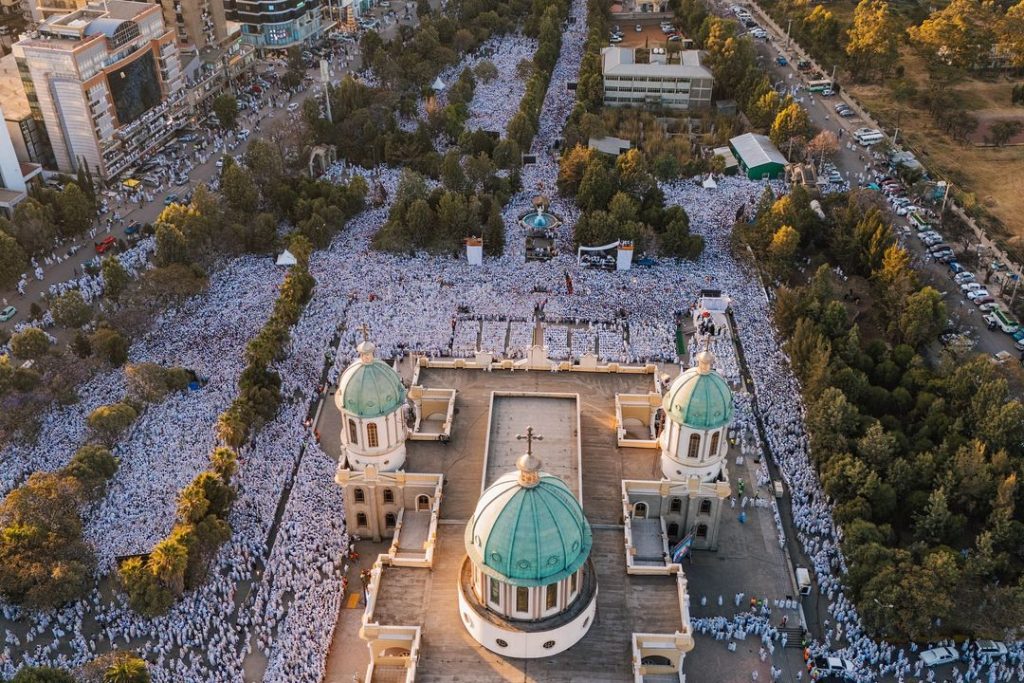

Worshippers dress in traditional white garments called shamma with brightly colored embroidered borders. The service itself is an immersive experience; think less “sit quietly in pews” and more “full sensory engagement” with chanting, drumming, and ritual movements.
After church, families feast, having fasted for the 43 days of the Advent season (called Tsome Nebiyat). Traditional foods include doro wat (spicy chicken stew) and injera (spongy sourdough flatbread). The fasting-to-feasting transition is dramatic and probably requires digestive system preparation.
Here’s where it gets interesting: after the feast, young men play a game also called Ganna, which resembles field hockey. Legend says shepherds played this game when they received news of Christ’s birth. Whether this is historically accurate or conveniently retroactive mythology, the tradition persists.
Ethiopian Christmas emphasizes community gathering, extended family connection, and church centrality in ways that many Western celebrations have lost in the shuffle of commercialization.
Philippines: Simbang Gabi and the Dawn Mass Marathon
The Philippines holds the possibly-unbeatable title for most dedicated Christmas celebration: Simbang Gabi (Night Mass), nine consecutive dawn Masses from December 16-24. That’s right, nine days of waking up at 3 or 4 AM to attend church before sunrise.
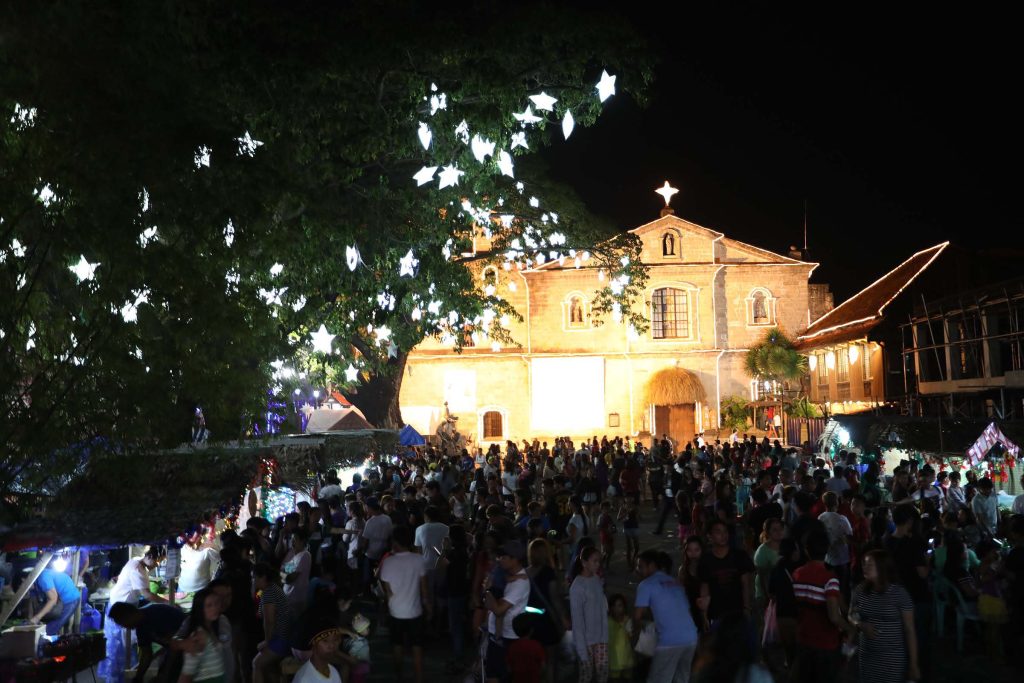
Tradition says if you complete all nine days without missing one, you earn the right to make a special wish. Whether divine intervention actually guarantees wish fulfillment remains theologically disputed, but the tradition motivates thousands of Filipinos to set very early alarms.
After each Mass, vendors sell traditional Filipino breakfast foods: puto bumbong (purple rice cakes), bibingka (rice cakes with cheese and eggs), and salabat (ginger tea). The food element transforms the religious obligation into a social event; you’re not just attending Mass, you’re participating in community breakfast tradition.
On Christmas Eve, after the final Simbang Gabi (called Misa de Gallo, “Rooster’s Mass”), families gather for Noche Buena. The midnight feast. This is where the real celebrating happens: extended family, excessive food, gift exchanges, and often karaoke stretching into early morning hours.
The Filipino approach combines serious religious devotion with joyful celebration in a way that neither diminishes the other. It’s impressive dedication wrapped in community festivity.
Mexico: Las Posadas and Reenacting the Journey
From December 16-24, Mexican communities celebrate Las Posadas (The Lodgings), reenacting Mary and Joseph’s search for shelter in Bethlehem. The tradition is literally acting out being rejected repeatedly, which is either deeply meaningful or slightly masochistic depending on your perspective.
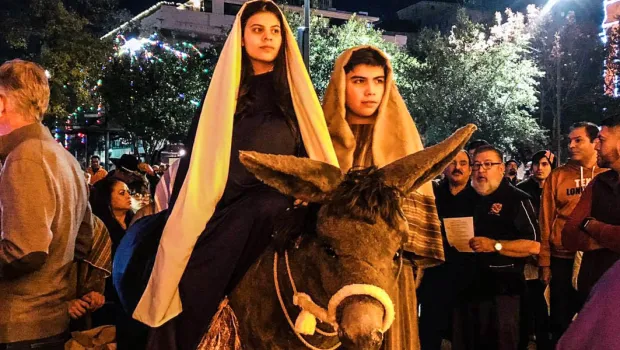
Each night, a procession of neighbors travels from house to house, with two people designated as Mary and Joseph. At each house, they sing verses requesting shelter. The homeowners sing back refusing entry. This continues until they reach the designated host house, which finally accepts them.
Then everyone goes inside for a party.
The celebration includes traditional foods (tamales, ponche), breaking a star-shaped piñata (representing the devil being defeated. So, theological violence against paper-mâché), and often giving small gifts to children. It combines religious reenactment, community building, and sugar consumption in one efficient tradition.
The final Posada on December 24th is the most elaborate, followed by Midnight Mass and then Christmas Day celebration. Mexican Christmas is less about a single day and more about a nine-day community journey.
Poland: Wigilia and the 12-Course Marathon
Polish Christmas Eve celebration, called Wigilia (The Vigil), features a 12-course meatless feast. Twelve courses. Meatless. On Christmas Eve.
The number twelve references the apostles (always with the apostle symbolism), and the meatless requirement extends the Advent fast one final day before Christmas.
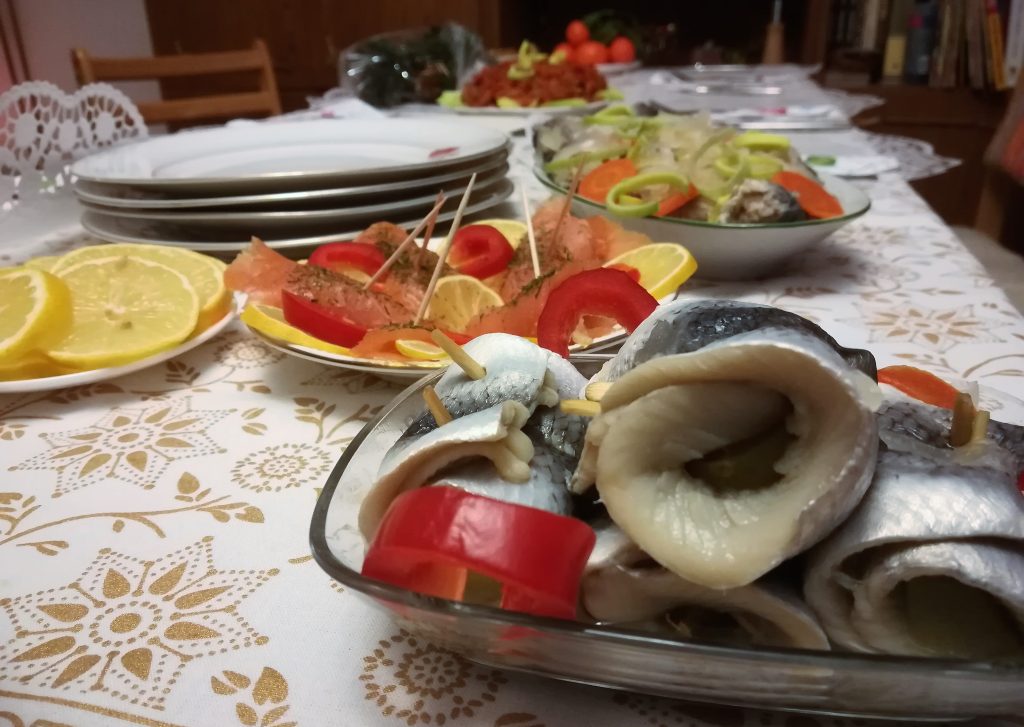

The meal begins when the first star appears in the sky, commemorating the Star of Bethlehem. An extra place setting is left at the table for an absent family member or unexpected guest; a tradition reflecting hospitality and remembrance.
The courses aren’t massive portions (think multiple small dishes rather than twelve thanksgiving-sized plates), but they’re specific and traditional: barszcz (beet soup), pierogi, carp (yes, fish counts as meatless in Polish Catholic logic), various salads, and makowiec (poppy seed cake).
Before eating, families share opłatek (Christmas wafers blessed by a priest), breaking pieces with each person while offering good wishes. It’s communion-adjacent but familial rather than ecclesiastical.
After dinner, families attend Pasterka (Shepherd’s Mass) at midnight, then return home to finally open presents. It’s a marathon of ritual and tradition that makes American Christmas celebrations look positively minimalist.
Sweden: St. Lucia Day and the Fire Hazard Procession
On December 13th, Sweden celebrates St. Lucia Day with a tradition that involves children wearing lit candles on their heads. Let’s pause on that detail: lit. candles. on. heads.
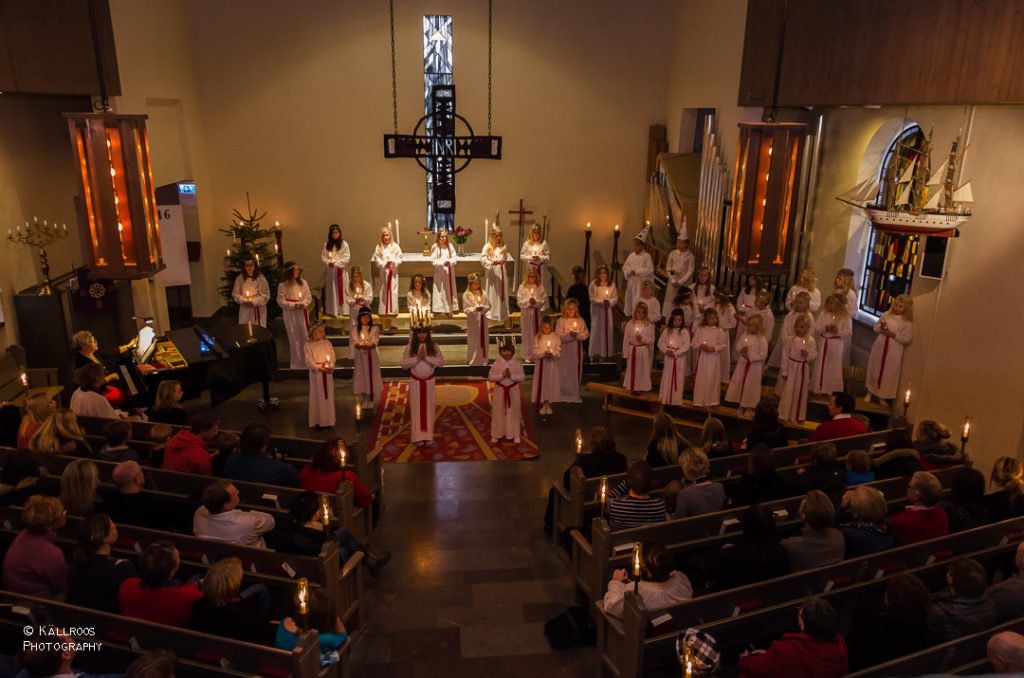

The eldest daughter in a family traditionally dresses in a white dress with a red sash and a crown of candles (now usually battery-powered, because reasonable safety precautions eventually prevailed). She serves saffron buns (lussekatter) and coffee to family members, accompanied by other children dressed as “star boys” and gingerbread men.
Schools and churches hold Lucia processions with lines of white-clad singers processing through darkened spaces while singing traditional songs. It’s visually stunning and thematically powerful; light entering darkness, which connects to Christmas themes even though St. Lucia’s feast day predates Christmas by nearly two weeks.
The tradition originated from stories of St. Lucia (martyred in 4th-century Sicily) bringing food to Christians hiding in Roman catacombs, wearing candles on her head to keep her hands free. How this Sicilian saint became Sweden’s biggest pre-Christmas tradition involves centuries of cultural blending and possibly some creative historical interpretation.
Swedish Christmas proper (December 24th evening, because Sweden celebrates Christmas Eve rather than Christmas Day) features julbord (Christmas table): a smorgasbord of pickled herring, meatballs, sausages, ham, Janssons frestelse (potato and anchovy casserole), and various desserts. Gift-giving happens after dinner, and families watch Donald Duck cartoons (this is not a joke, it’s a genuine Swedish Christmas tradition since 1959).
South Korea: Mega-Churches and Cultural Celebration
South Korea has one of the world’s largest Christian populations in Asia (about 30% of the population), and their Christmas celebrations blend Korean culture with Christian practice in fascinating ways.
Major churches hold elaborate Christmas services with professional-quality productions: think full orchestras, massive choirs, dramatic lighting, and multimedia presentations. Some of Seoul’s mega-churches seat thousands and fill multiple services on Christmas Eve and Christmas Day.
Many Korean Christians attend early morning prayer services (sabyeok kido) throughout December, continuing their year-round tradition but with Christmas themes. These 5 AM prayer gatherings might seem extreme, but they’re normal within Korean Christian practice.
Public Christmas celebration in Korea is relatively recent but enthusiastic. Cities display elaborate light installations, Christmas music plays in shopping districts, and couples celebrate Christmas as a romantic holiday (similar to how Valentine’s Day functions in the West). The secular and religious coexist without much tension.
Christmas is an official public holiday in South Korea (one of the few Asian countries where this is true), which facilitates both religious observance and cultural celebration.
What We Learn From Global Diversity
These varied traditions reveal something significant: Christianity adapts to local cultures without losing core theological elements. The universal message (God became human) expresses through particular cultural forms.
Ethiopian Christians emphasize communal fasting and feasting. Filipino Christians show devotion through sustained early-morning commitment. Mexican Christians reenact the nativity story through neighborhood participation. Polish Christians express faith through elaborate family ritual. Swedish Christians integrate pre-Christian light symbolism with Christian themes. Korean Christians create grand public worship.
All celebrate the same event. None celebrate identically.
This diversity is a feature, not a bug. It demonstrates that the Christmas story transcends any single cultural expression.
The gospel message isn’t imprisoned in European tradition or American commercialism; it’s portable, adaptable, and perpetually relevant across vastly different contexts.
Also, it proves that no one has a monopoly on the “correct” way to celebrate. Your family’s traditions are no more or less authentic than traditions practiced for centuries in cultures you’ve never encountered.
Christmas is bigger than any of us assumed. That’s either unsettling or liberating, depending on how attached you are to your version being definitive.
Keeping Christ in Christmas: Practical Ways Modern Christians Navigate the Holidays
Every December, some well-meaning Christian somewhere posts a meme or makes a comment about “keeping Christ in Christmas,” usually with mild irritation about how commercialized the holiday has become. This complaint is older than anyone making it; religious leaders have been criticizing Christmas commercialization since at least the 19th century. The tension between spiritual observance and cultural celebration is permanent.
But beyond complaining about retail excess and muttering about “the reason for the season”, how do Christians actually maintain religious focus during a holiday that involves sales ads, Santa myths, and frankly exhausting logistical demands?
Here are practical approaches that actual Christians use, ranging from intensely devout to moderately intentional.
Creating a Home Advent Wreath
Setting up an Advent wreath at home transforms a church tradition into family practice. You’ll need:
- A circular wreath base (greenery, wire frame, or just a decorative circle)
- Four candles (three purple, one pink/rose, or just four matching candles if you’re less liturgically particular)
- Optional: a fifth white Christ candle for the center
Each Sunday of Advent, gather the family and light the appropriate candle(s). Read a short scripture passage related to the week’s theme (Hope, Peace, Joy, Love), pray together, and maybe sing a carol if your family is the singing type.
The beauty is in the weekly rhythm. It creates anticipation, marks time, and provides a built-in opportunity for spiritual conversation that doesn’t feel forced. Plus, candles are inherently atmospheric; even kids who’d normally resist religious activity tend to find fire interesting.
Some families add nightly devotional readings throughout Advent, turning the wreath into a daily practice rather than just weekly observance.
Daily Advent Devotionals and Scripture Reading
Numerous Advent devotional guides exist, ranging from simple daily scripture readings to elaborate reflection materials. Find one that matches your attention span and theological preferences.
Options include:
- Traditional liturgical readings following the church calendar
- Thematic devotionals focusing on specific aspects of Christmas
- Family-friendly versions with activities for kids
- Contemplative readings emphasizing silence and reflection
The key is consistency. Reading for 5-10 minutes daily creates a counter-narrative to the consumer frenzy happening externally. It’s spiritual grounding amid chaos.
Many churches provide Advent devotionals free or cheap. Alternatively, apps like Youversion or Bible Project offer structured options.
Incorporating Prayer Into Holiday Preparations
This sounds simple but easily gets lost: pray. Specifically, pray while doing Christmas-related tasks.
Wrapping presents? Pray for the recipient while wrapping. Baking cookies? Thank God for abundance and pray for those who lack it. Addressing Christmas cards? Pray for each person as you write. Decorating the tree? Reflect on the incarnation’s significance.
You’re doing these activities anyway. Adding prayer doesn’t require additional time, just intentional awareness during existing tasks.
This approach reframes secular activities as potentially holy moments. The line between sacred and mundane blurs when you invite the sacred into the mundane.
Fasting Practices (Yes, Really)
Traditional Advent observance included fasting similar to Lent. Most modern Western Christians have abandoned this, but some maintain modified versions:
- No meat Fridays during Advent (Catholic tradition, though less commonly followed now)
- One day per week fasting from a specific food (sugar, caffeine, etc.)
- Fasting from screens/entertainment to create space for reflection
- Limiting shopping or consumption during Advent
The point isn’t punishment; it’s creating space. When you remove something habitual, the empty space becomes available for something else, like actually thinking about what you’re supposedly preparing for.
Fasting also connects modern believers to historical Christian practice, participating in ancient rhythms maintained by Christians across centuries.
Charitable Giving as Spiritual Practice
Many Christians intentionally incorporate service and giving into Christmas celebration, viewing it as response to God’s gift of Christ.
Practical approaches:
- Alternative gift-giving: Donate to charities in someone’s name instead of buying physical gifts
- Adopt-a-family programs: Providing gifts and meals for families in need
- Volunteering: Serving at soup kitchens, homeless shelters, or community organizations
- Giving to global missions: Supporting international relief and development work
- Church special offerings: Many churches collect special Christmas donations for specific needs
The theological connection: Christians believe God gave humanity the ultimate gift. Responding with generosity reflects that divine generosity toward others.
It also provides practical meaning beyond retail consumption. Giving to others fulfills something gifts-for-people-who-have-everything cannot.
Simplified Celebrating: Less Consumerism, More Contemplation
Some Christian families intentionally simplify Christmas to maintain focus:
- Limiting gifts: “Something you want, something you need, something to wear, something to read” or similar rules
- Homemade gifts: Emphasizing thought and effort over expense
- Experience-based gifts: Giving time, activities, or shared experiences rather than stuff
- Delayed celebrations: Opening gifts after Christmas Day to prevent the holiday from being only about presents
- Minimal decorating: Avoiding the competition to create elaborate displays
This approach counters cultural pressure toward excess. It’s not about being Scrooge-like but about intentionality; choosing meaning over momentum.
The challenge is navigating family expectations and children’s desires for “normal” Christmas experiences. Balance is tricky.
Family Worship Traditions and Christmas Eve Readings
Many families create home worship traditions:
- Christmas Eve scripture reading: Reading Luke 2 together before bed
- Singing carols together: Actually using those voices for hymns, not just car sing-alongs
- Prayer before gift opening: Acknowledging God’s generosity before celebrating human gift-giving
- Nativity scene placement: Progressively moving figures toward the manger throughout December, adding the baby Jesus on Christmas morning
These practices weave spiritual elements into family traditions, making faith part of holiday memory rather than separate from it.
Children who grow up with these traditions often maintain them into adulthood, even if they drift from regular church attendance. The embodied, family-level practices stick in ways abstract theology doesn’t.
Balancing Secular and Sacred Holiday Elements
Here’s the honest truth: most Christian families don’t choose between secular and sacred Christmas elements. They combine both, sometimes awkwardly.
Santa Claus coexists with nativity scenes. Secular Christmas movies play alongside attending church services. Gift obsession happens despite theological claims about simplicity.
Some families navigate this by:
- Being explicit about differences: Teaching kids that Santa is fun pretend while the Christmas story is believed truth
- Sequential focus: Emphasizing Advent as preparation/spiritual time, then allowing more secular celebration after Christmas arrives
- Compartmentalizing: Keeping sacred elements in specific spaces/times rather than trying to make everything spiritual
- Accepting tension: Acknowledging the contradiction without resolving it perfectly
The sacred-secular tension isn’t solvable. It’s just the reality of living in a culture that celebrates Christmas both as religious holy day and secular holiday. Most Christians muddle through this imperfectly, like most aspects of faith.
Apps and Resources for Christian Christmas Observance
Modern technology offers tools for maintaining spiritual focus:
- Bible reading plans: YouVersion and other Bible apps offer Christmas-specific reading plans
- Christmas carol apps: Learning lyrics and history of traditional hymns
- Church service livestreams: For those unable to attend in person
- Christian podcasts: Many release Christmas-specific episodes discussing theology and tradition
These resources make spiritual content accessible; no excuse that you don’t have time to drive to church or buy a physical devotional book. The material is available on devices you’re already staring at constantly.
The irony of using technology to combat technology-driven distraction isn’t lost on anyone, but practicality sometimes trumps poetic consistency.
Finding Meaning Amid Holiday Madness
Here’s the core challenge: Christmas happens whether you’re spiritually prepared or not. December 25th arrives regardless of your Advent devotion consistency. Family obligations and cultural expectations press in from all sides.
Christians trying to maintain spiritual focus aren’t attempting to create perfect holy experiences. They’re trying to notice sacred moments within inevitable chaos.
The goal isn’t achieving some idealized, peaceful, purely spiritual Christmas.
The goal is remembering (even sporadically, even imperfectly) that beneath the wrapping paper and family drama and logistical stress is a story about God entering human messiness.
If that awareness surfaces even occasionally during the season, you’re probably doing fine.
And if you totally lose the plot and Christmas becomes just a stressful consumer obligation? There’s always next year. Christianity is built on concepts like grace, forgiveness, and trying again.
That might be the most important Christmas lesson of all.
Two Thousand Years later
Two thousand years ago (give or take a few years, because historical dating is imprecise) something happened in an insignificant province of the Roman Empire. Whether you believe it was the incarnation of God or just another birth in occupied Judea depends on your theological commitments, but Christians have been commemorating this event ever since with varying degrees of elaborateness, devotion, and success.
The traditions we’ve explored — from the somber preparation of Advent to the elaborate feasts of Wigilia, from the predawn dedication of Simbang Gabi to the candle-crowned celebrations of St. Lucia Day — reveal Christianity’s remarkable capacity for cultural adaptation. The core claim remains constant: the divine became human. How communities express this belief varies spectacularly.
Modern Western Christmas exists in perpetual tension between spiritual and commercial, between sacred observance and secular celebration, between meaningful tradition and obligatory performance. Most Christians navigate this tension imperfectly, oscillating between genuine devotional moments and just trying to survive the season without strangling anyone during the church Christmas pageant. Both experiences are valid.
What makes Christian Christmas traditions powerful isn’t their perfection or uniformity. It’s their persistence across centuries, cultures, and circumstances. For two millennia, believers have gathered in grand cathedrals and house churches, at midnight and dawn, in prosperity and poverty, to mark this impossible claim: that the infinite God chose to enter human existence as a vulnerable infant, born to an unmarried teenager in occupied territory, surrounded by animals rather than aristocracy.
Whether you attend midnight Mass seeking transcendent spiritual experience or just to keep your grandmother happy, whether you meticulously maintain Advent devotions or frantically read Luke 2 on Christmas Eve, whether your nativity scene is elaborate or nonexistent, you’re participating in something ancient and audacious.
These traditions connect you to billions of people across time and geography who have also paused amid life’s chaos to consider the possibility that God values humanity enough to become human. That’s worth acknowledging, even between the wrapping paper, the family arguments, and the inevitable post-Christmas letdown.
The sacred and the silly coexist at Christmas, just as divinity and humanity allegedly coexisted in that Bethlehem manger. Neither invalidates the other.
Maybe that’s the real miracle: not that something cosmically significant happened two thousand years ago, but that humans keep finding meaning in it despite commercialization, despite theological disputes, despite everything working against sincere observance.
Or maybe it’s both. Christians bet everything that it’s both.
Explore More Global Celebrations:
- Christmas Around the World: KFC, Krampus, and Roller Skates
- Discover how different cultures celebrate Easter
- Learn about Islamic observances of Ramadan and Eid
- Explore the Hindu festival of Diwali across continents